The Guide To Choosing The Perfect Hotel Bedding Sets
Jun 30, 2026
Hotel linen covers sheets, duvet covers, pillowcases, duvet inserts, pillow inserts, mattress protectors. It is the key soft furnishing that shapes room texture, sleep comfort, hygiene scores and guest reviews. Unlike household fabrics, hotel linen has to withstand frequent industrial washing.
Many hotel buyers make costly mistakes when sourcing. They only judge products by price or hand feel, and easily fall for merchants' hype around high yarn counts. The linen they buy pills, yellows, shrinks and deforms after a few washes, pushing up long-term operating expenses. This guide compiles a complete, operable set of purchasing standards covering fabric types, yarn & thread counts, and tiered solutions for different hotel grades.

Main Types of Hotel Linen Fabrics
Pure cotton remains the most popular material for hotel bedding. It breathes well, feels gentle on skin, and withstands high-temperature bleach and disinfection treatments, fully satisfying hygiene regulations for star hotels.
|
Fabric Type |
Matching Yarn Count |
Suitable Hotel Positioning |
Key Notes for Purchase |
|
Carded Cotton |
40S |
Budget hotels, budget chains, homestays |
Pick products above 200TC to avoid pilling caused by low density |
|
Combed Cotton |
60S |
3 & 4-star hotels, mid-range business chains, boutique hotels |
Choose 290–310TC high density to stop fiber leakage and resist industrial washing damage |
|
Long-staple Cotton |
80S |
Five-star hotels, luxury resorts, ultra-luxury homestays |
Confirm genuine single-ply long-staple cotton; reject falsely labeled multi-ply goods |
|
Poly-cotton Blends |
40S |
Ultra-low-budget venues |
Only for temporary use; not recommended for long-term commercial service to avoid guest complaints |
- Carded Cotton
It is thick, wear-resistant and budget-friendly, suitable for frequent washing cycles.
Best match: budget hotels, budget chains and homestays.
Drawback: The texture lacks delicacy and a premium look.
- Combed Cotton
The combing process removes short fibers, delivering smooth, pill-resistant fabric that stays intact after repeated washing without shrinkage.
60S combed cotton is recognized as the industry's golden standard, balancing softness, appearance, durability and cost. Around 90% of mid-to-high-end hotel chains adopt it.
- Long-staple Cotton
Long fibers create silky fabric with subtle soft luster and outstanding skin-friendliness.
Only suitable for high-end resorts and flagship five-star hotels.
Reminder for buyers: Mid-range hotels are not advised to choose it. It comes with a steep price, wears out fast and delivers poor cost performance.
- Poly-cotton Blends
Wrinkle-free, iron-free and low-priced with simple maintenance.
Drawback: Poor air permeability; unable to bear regular high-temperature bleaching; low-grade appearance.
Only fit venues with extremely tight budget constraints for temporary use.
Yarn Count and Thread Count
Never rely solely on sales pitches when buying linen. Focus on two core technical indicators: yarn count (S) and thread count (TC).
Yarn Count
- 40S: Thick and durable, widely used in budget hotels
- 60S: Fine and soft, standard for four-star and boutique hotels
- 80S and above: Ultra-thin and silky, exclusive to top five-star properties
Thread Count
- Matching standard for 40S fabric: 200–210 high TC
- Matching standard for 60S combed cotton: 290–310 TC
- Matching standard for premium 80S fabric: 380–450 TC
|
Yarn Spec |
Standard Thread Count |
Suitable Hotel Type |
Critical Pitfall Avoidance |
|
40S |
200–210 |
Budget hotels, budget homestays |
Avoid fabric below 200TC, which pills and wears out quickly |
|
60S |
290–310 |
3 & 4-star business hotels, mid-range boutique chains |
Insist on around 300TC high density; stay away from deceptive high-yarn-low-density products |
|
80S+ |
380–450 |
Five-star hotels, luxury resorts |
Request inspection reports to verify single-ply cotton; refuse mislabeled multi-ply linen |
Industry common sense: Products marked with high yarn count but low thread count are counterfeit quality. They feel soft at first but shed fibers and become unusable after just two washes. Always match yarn count with corresponding thread count: 40S pairs with roughly 200TC, 60S with around 300TC, and 80S with about 400TC to meet industry compliance standards.
Purchasing Standards for Duvet Inserts, Pillow Inserts and Towels
Duvet Inserts
Luxury hotels: White duck or goose down duvets, lightweight and fluffy with no heavy pressure on bodies
Mid-range hotels: High-elastic hollow fiber duvets, anti-clumping, machine washable and mold-proof
Budget hotels: Regular three-dimensional fiber duvets with high cost performance
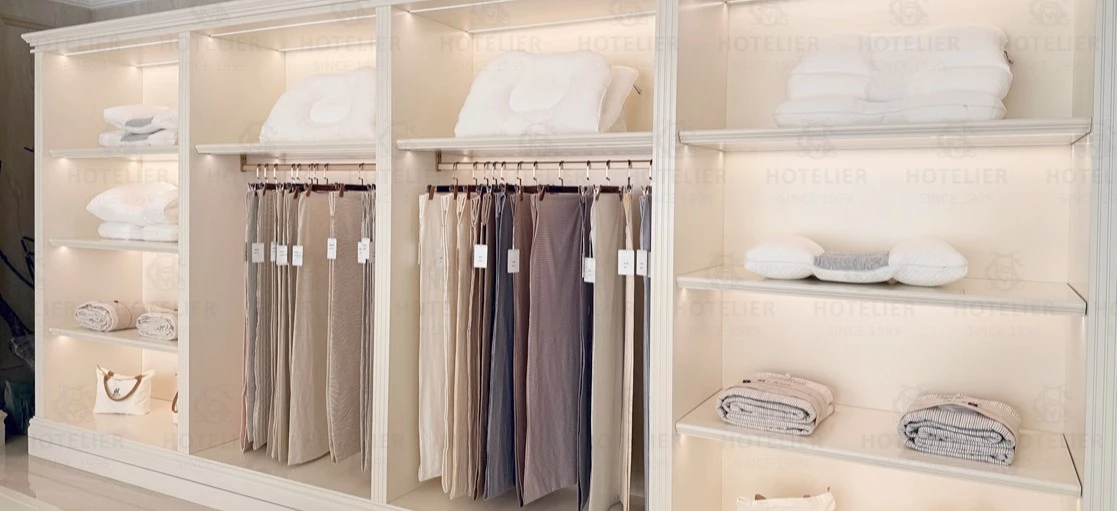
Pillow Inserts
All hotels must provide two pillows of different firmness per bed
Soft low-loft pillows: For guests who sleep on their backs or stomachs
Firm supportive pillows: Protect cervical vertebrae for side sleepers
High-end hotels can upgrade to latex pillows, which inhibit bacteria and dust mites and raise guest satisfaction.
Three Widespread Misconceptions in Hotel Linen Procurement
Misconception 1: The shinier the fabric, the higher the grade
Shiny sateen looks fancy, yet it traps body heat, snags easily and degrades rapidly under industrial washing. Hardly any formal star hotels use it for daily guest rooms.
Authoritative hotels all adopt matte plain-weave combed cotton, which stays dry, breathable and turns softer after every wash.
Misconception 2: Stiff new linen means poor quality
New linen carries eco-friendly sizing agent from production to keep beds neatly made. The coating washes off after 3 to 6 laundry cycles, leaving fabric soft and fluffy - this is a normal condition, not a quality defect.
Misconception 3: Blind pursuit of 80S or 100S ultra-high yarn counts
Most 80S linen on the market uses twisted multi-ply yarn instead of genuine single-ply long-staple cotton. Such fabric traps heat, lacks ventilation and pills severely, making it unsuitable for hotel commercial washing.
Targeted Procurement Solutions for Different Hotel Grades
Budget Hotels
- Fabric: 40S carded cotton or poly-cotton blends
- Thread count: 200TC
- Filling: Standard fiber duvets and regular pillows
- Style: Plain all-white, durable with low long-run maintenance costs
Mid-range Hotels
- Fabric: 60S combed cotton (industry golden standard)
- Thread count: 300TC high-density weave
- Filling: High-elastic hollow fiber duvets, soft and firm dual pillows
- Texture: Smooth surface, anti-pilling and anti-shrinking with elegant appearance
Luxury Hotels
- Fabric: 80S long-staple cotton
- Thread count: 380TC and above ultra-high density
- Configuration: Down duvets, latex pillows, heavy-weight towels, custom embroidered linen
- Features: Soft luster, silky touch and premium sleeping experience
|
Hotel Tier |
Core Fabric |
Standard Thread Count |
Filling Setup |
Core Style & Requirements |
|
Budget Hotels |
40S carded cotton / poly-cotton blends |
200TC |
Regular fiber duvets, standard pillows |
Plain white, durable and low operating costs |
|
Mid-range Hotels |
60S combed cotton |
300TC |
High-elastic hollow fiber duvets, soft & firm pillows |
Smooth, pill-proof, shrink-resistant with timeless elegant look |
|
Luxury Hotels |
80S long-staple cotton |
380TC+ |
Down duvets, latex pillows, heavy towels, custom embroidery |
Soft luster, silky texture and top-tier sleep experience |
Laundry Rules & Replacement Cycles for Hotel Linen
Purchasing is only the first step; proper laundry maintenance determines product service life.
Laundry Specifications
- Wash sheets, duvet covers and pillowcases uniformly at 60°C for full sterilization
- Do not use fabric softener ,it hardens fabric, blocks air flow and accumulates dust
- Separate heavily stained linen to avoid color bleeding
Industry Standard Replacement Cycles
- Sheets, duvet covers, pillowcases: Full batch replacement every 1–2 years
- Pillow inserts: Replace every year
- Duvet inserts & mattress protectors: Replace every 3–5 years
Conclusion
When purchasing hotel bedding, a higher price does not necessarily mean better quality. Adhere to core standards: match the fabric with the hotel's positioning, select the appropriate count and hotel configuration.
Economy hotels prioritize durability and cost; Mid range hotels seek a balance between value and quality; Luxury hotels prioritize a high-quality guest experience. By selecting the appropriate yarn and fabric craftsmanship to avoid common marketing traps, you can create the perfect hotel bedding at a reasonable cost.
If you have any questions about linen selection and specification matching, the HOTELIER supports hotel projects of all grades and across all climate zones, ready to deliver tailored, practical textile solutions for your property.