Procurement Guide of Bathroom Linen for Different Types of Hotels
Jun 21, 2026
Many hotel purchasers only compare the unit purchase price of towels while ignoring core indicators such as GSM weight and terry loop weaving craftsmanship. This frequently leads to recurring problems including heavy lint shedding, fabric hardening and yellowing after laundry. There are clear disparities in fabric standards and weaving techniques for bathroom towels, floor mats and bathrobes among budget chain inns, mid-tier business hotels and high-end resorts. This article fully explains the selection logic for complete sets of bathroom linen, covering fabric materials, GSM grading and weaving processes, to serve as a reference for hotel procurement specialists.
1 Do not merely focus on the lowest price
The production of hotel bathroom linen is concentrated in textile industrial zones, leading to an enormous price gap across the market; a single bath towel costs anywhere from 3 to 20 yuan. Chaotic practices run rampant in the industry for four main reasons:
- Low-cost towels adopt thin single terry loops. After merely 20 to 30 laundry cycles, large-scale loop shedding and rigid hardening occur, drastically reducing water absorption. Guests are left covered in lint after drying themselves, triggering surges of negative online reviews.
- Manufacturers cut corners on fabric finishing by skipping mercerization and anti-yellowing treatments. After repeated cleaning with disinfectants, the towels turn uniformly yellow, creating a cheap visual impression inside guest rooms.
- Coastal and hot spring hotels overlook anti-mold finishing. Mildew spots and unpleasant odors develop on towels after half a month of storage, directly resulting in point deductions during star-rated hotel sanitation inspections.
- Floor mats are produced with reduced GSM weight and no anti-slip patterns on the base. When water accumulates in shower areas, friction is insufficient, creating high risks of guest slip-and-fall compensation claims.
Per the assessment specifications for star-rated hotels:
- The minimum GSM for towels in budget hotels shall not be lower than 400;
- Bath towels for mid-tier business hotels shall be 500 GSM or higher;
- Bath towels for four-star, five-star and hot spring resorts shall reach 600 GSM, with thickened matching floor mats and bathrobes.
Hotels operating in different regions and business models cannot adopt a universal procurement standard. Blind cost reduction or over-specification will both cause long-term capital waste.
Hotel Towel GSM Reference Table
|
GSM Range |
Weight Class |
Best For |
Guest Perception |
|
300–400 |
Lightweight |
Gym, swimming pool, beach areas, budget guest rooms |
Thin texture, quick-drying yet perceived as low-grade |
|
400–500 |
Medium |
Mid-tier (3-star) hotels |
Acceptable texture, fully functional |
|
500–600 |
Premium |
Most hotels aiming to deliver a luxury experience |
Optimal balance: soft, absorbent and easy to launder |
|
600–700 |
Luxury |
5-star hotels, spas, premium suites |
Thick and fluffy, requires longer drying time |
Industry consensus identifies 500–700 GSM as the target range for guest bathroom towels. Within this bracket, 600 GSM achieves the perfect balance between fluffy texture and practical industrial laundering performance.
2 Functional Breakdown of All Bathroom Linen Products
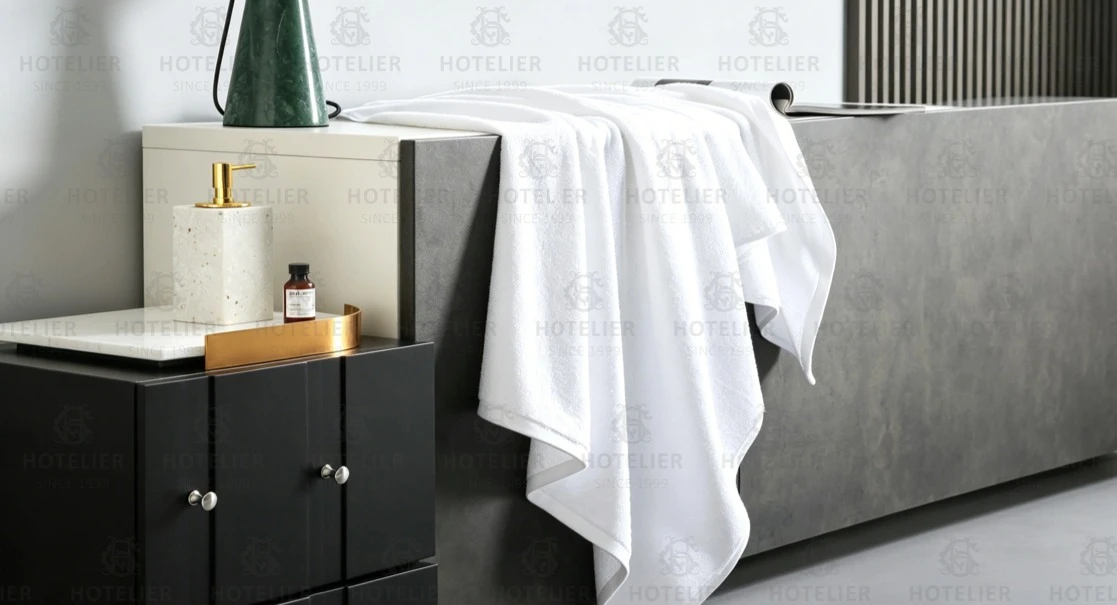
A complete set of hotel bathroom linen consists of five core items: hand towels, face towels, bath towels, floor towels and bathrobes, each with distinct irreplaceable functions. Matching specifications must be selected for all items during procurement:
- Hand towel: The smallest bathroom textile, placed on washbasins for hand and facial wiping to elevate refined room aesthetics.
- Face towel: A daily necessity for guests' facial cleansing with the highest usage frequency and fastest wear rate.
- Bath towel: The core bathing product for full-body water absorption; its texture and GSM directly determine guests' shower experience.
- Floor towel: Laid outside shower entrances to block water and provide anti-slip performance, eliminating safety hazards of slipping on wet floors.
- Bathrobe: Supporting amenity for guest rooms, spas and hot spring venues, split into lightweight waffle styles and thick terry styles to boost vacation ambiance.
3 Classification of Mainstream Towel Fabrics Matched to Hotel Tiers
All bathroom textiles adopt a terry loop structure. The quality of cotton raw material directly determines softness, water absorption and lint shedding levels. Three mainstream fabric types are available on the market:
1. Standard Combed Cotton – Basic Option for Budget Homestays & Express Inns
Made from short-staple combed cotton with single-loop weaving.
Advantages: Low procurement cost and high cost-performance for low-budget venues.
Disadvantages: Short fibers lead to severe lint shedding after washing; without mercerization treatment, fabrics turn yellow and rigid after repeated laundering.
Suitable for short-stay budget business hotels with rough outsourced laundry cycles.
2. Premium Combed Cotton – Universal Selection for Mid-Tier Chain Business Hotels
Manufactured with extended cotton fibers and double terry loop weaving, paired with hydrophilic and anti-mold post-finishing. It absorbs water rapidly with minimal loose lint, resisting deformation and yellowing after 100 industrial wash cycles, and performs stably in both dry and humid environments. It is the top fabric choice for urban business hotels.
3. Long-Staple Cotton – Exclusive for Five-Star & High-End Hotels
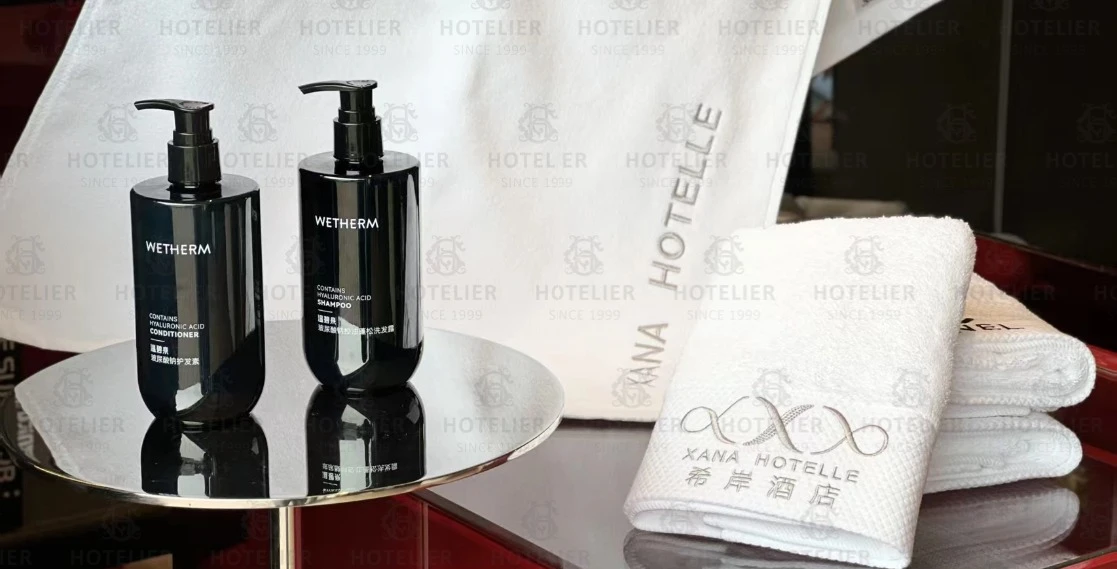
Crafted with high-count long cotton fibers and thickened double terry loops. Pre-washed at the factory to remove surface lint, compatible with double mercerization and chlorine-resistant bleaching treatments. The fabric maintains silky softness without aging or hardening after repeated disinfection washing, with top-tier moisture-proof and anti-mold performance. It is ideal for hot spring and coastal resorts exposed to persistent dampness and frequent sterilization.
4 GSM Grading Thresholds by Hotel Positioning
Hotel Towel GSM & Craft Standard Comparison Table
|
Hotel Positioning |
Hand Towel GSM |
Face Towel GSM |
Bath Towel GSM |
Floor Towel GSM |
Core Craft Requirements |
|
Budget Homestays & Express Inns |
300–350 |
350–400 |
400–480 |
450 |
Basic single terry loop craft |
|
Mid-Tier Business Chain Hotels |
400 |
450–500 |
550–620 |
500 |
Double terry loop + anti-mold treatment |
|
5-Star Hotels & Vacation Resorts |
450 |
520 and above |
650–700 |
600 |
Thickened double long-staple terry loop, chlorine-resistant bleaching & anti-mold treatment |
Mandatory Supplementary Clauses for Procurement Contracts
The GSM weight deviation of towels within one delivered batch shall not exceed ±20g; full batches may be rejected if this error limit is exceeded.
All towel varieties furnished in a single guest room must maintain consistent thickness, GSM weight and craftsmanship to avoid mismatched visuals that downgrade room quality perception.
Third-party GSM test reports shall be provided for all towels, with test data fully consistent with contracted standards.
5 Weaving & Post-Finishing Processes
1. Terry Loop Weaving Craft
Single terry loop: Single-layer loop structure with low production cost, prone to loop detachment and lint loss; only applied to low-end products.
Double terry loop: 3D double-layer loops with superior water storage and absorption capacity, resistant to detachment under tension; mandatory standard for mid-tier and premium hotels.
2. Key Functional Post-Finishing Treatments
- Mercerization: Creates delicate luster on cotton fibers, maintaining long-term bright white without dullness.
- Anti-yellowing treatment: Prevents discoloration after long-term chlorine disinfection bleaching.
- Chlorine resistance: Essential for hot spring venues and hotels with frequent sterilization, slowing fabric aging and hardening.
- Hydrophilic softening: Accelerates water absorption for residue-free drying.
- Anti-mold finishing: Designed for rainy coastal cities, eliminating mildew and odors during storage and shipping.
3. Sewing Acceptance Standards
All towels feature high-density double stitching on four edges with triangular fabric reinforcement at four corners, preventing thread breakage and edge splitting after repeated twisting and drying. Bathrobe cuffs and belt seams receive multi-layer reinforcement to avoid tearing from long-term wear.
6 Two Bathrobe Fabric Options for Different Seasonal Scenarios
- Waffle Bathrobe
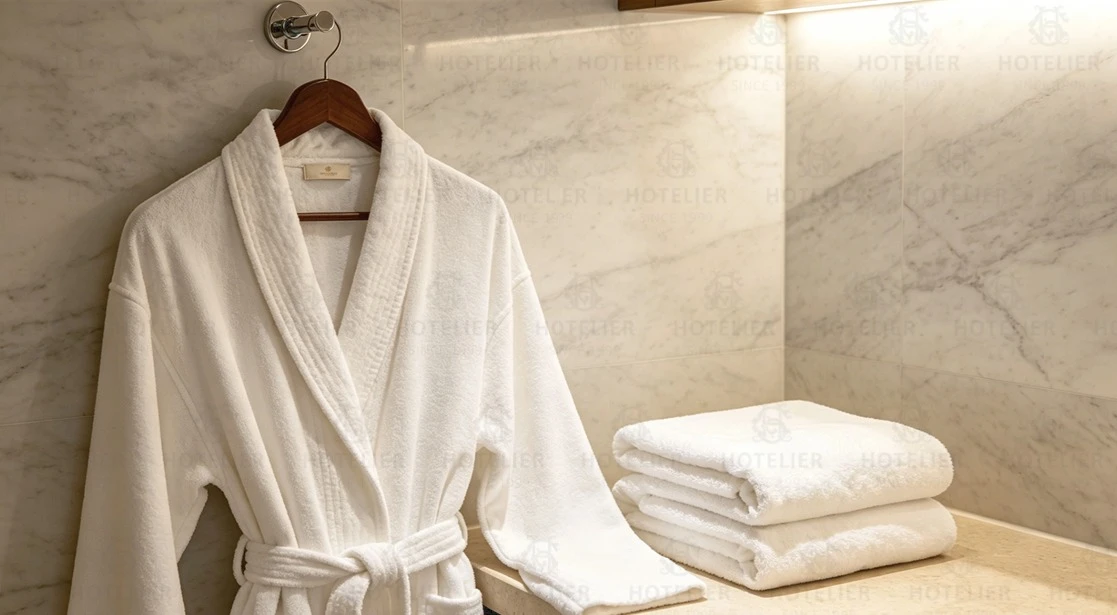
Lightweight, breathable and quick-drying with low self-weight. Suitable for spring, summer, hot springs and spas. The fabric resists moisture buildup, making it ideal for humid southern regions.
- Velour Bathrobe
Thick and heat-retaining with ultra-soft skin contact. The top choice for five-star hotels in dry northern regions during autumn and winter, and supports large 3D embroidered brand logos for an elevated premium aesthetic.
7 Five Mandatory Factory Inspection Standards
- Lint loss test: Premium long-staple cotton towels generate minimal loose lint with no heavy flake shedding during wiping.
- Washing color fastness: White linens resist yellowing from chlorine bleaching; colored towels prevent color bleeding under dry and wet friction.
- Shrinkage rate: Total shrinkage after laundering ≤3%, with stable dimensions after repeated washing cycles.
- Sampling inspection: Factory screening for sparse terry loops, partial loop detachment, holes and stains.
- Microbial test: Zero residual bacteria and fungi, with qualified anti-mold performance for humid environments.
- Additional Contract Clause: If mass yellowing, severe lint shedding or excessive shrinkage is detected during delivery sampling, the supplier shall accept unconditional returns and bear all logistics costs.
8 Warehouse Storage, Restocking & Long-Term Maintenance Tips
- Storage Guidelines: Hotels in coastal or rainy regions require fully film-sealed packaging for all linen products, with desiccants placed inside warehouses to eliminate mildew odors from long-term stacking.
- Restocking Cycle: Towels and floor mats are high-consumption linens; conduct monthly inventory and replenishment. Upgrade fabric GSM and craftsmanship if the monthly loss rate exceeds 8%.
- Long-Term Supplier Cooperation: Partner with integrated factories covering weaving and sewing. Retain physical fabric color cards and GSM samples to guarantee uniform standards across all batches.
- Laundry Matching: Coordinate industrial washing parameters with laundry service providers at the time of procurement. Pair chlorine-resistant fabrics with high-temperature strong-alkali washing formulas to extend linen service life.
Conclusion
Procurement decisions must not rely solely on individual unit prices; select fabric GSM and materials matching the hotel's brand positioning. Focus on four core benchmarks: cotton raw material quality, double-loop weaving, anti-wash & anti-mold finishing, and anti-slip floor mats. This will cut hidden costs including frequent linen replacement and guest slip compensation claims, while refining the subtle service details of guest rooms. Developing standardized bathroom linen inspection checklists is the core strategy for hotels to achieve long-term cost control.