Hotel Linen Procurement Guide: Craft Standards And Hotel Scenario Adaptation
Jun 08, 2026
Ordinary household bedding is washed fewer than 50 times a year with mild cleaning procedures and no rigorous disinfection requirements. It only needs to look nice and feel soft for short-term use. In stark contrast, hotel linens endure harsh industrial washing throughout their service life, including high-temperature boiling, chlorine-based bleaching for stain removal, high-speed mechanical agitation, forced high-temperature drying and high-pressure pressing and finishing.
I. Core Principles of Hotel Linen Procurement
According to statistics from the International Hotel Purchasing Association, standard hotel linens are washed over 220 times per year. For resort hotels and downtown business hotels with large passenger flow, the annual washing frequency can reach 280 to 300 times.
Such fundamental differences in usage scenarios have led to a unified fabric grading standard for commercial hotels worldwide, which centers on two key indicators: Yarn Count (S) and Thread Count (TC). These are also the major distinctions between hotel procurement and home textile selection.
What is Yarn Count (S)?
Yarn count is a professional indicator to measure the thickness of yarn, marked as "S". It refers to the length that a unit weight of yarn can be stretched to. Adopting the widely used English standard: one pound (about 454 grams) of cotton yarn stretched to 840 yards (about 768 meters) is defined as 1 count (1S). If the length is a multiple of 840 yards, the yarn count increases accordingly.
- Yarn count is inversely proportional to yarn thickness. The higher the count, the finer the yarn, and the lighter, softer, more delicate and lustrous the fabric will be. The lower the count, the thicker the yarn, with higher toughness, tensile resistance and wear resistance.
- To put it simply, low-count fabrics focus on durability, while high-count fabrics focus on superior texture and appearance.
What is Thread Count (TC)?
TC, short for Thread Count, represents the total number of warp and weft yarns per square inch of fabric.
Calculation formula: TC = Number of warp yarns + Number of weft yarns.
- For example, a fabric marked 133×72 means 133 warp yarns and 72 weft yarns per square inch, with a TC value of 205. A higher TC means yarns are arranged more densely, making the fabric tighter, smoother and thicker. Fabrics with an excessively low TC are loose, see-through and prone to shrinkage and deformation.
- Those with an overly high TC have tiny pores and poor air permeability, and tend to overheat and become brittle during industrial washing. For commercial linens, fabrics with a TC of 200 to 420 deliver the best cost performance overal.
The Relationship between TC and Yarn Count
Based on long-term practical tests, the industry has set standard matching rules: 40s fabric matches 200TC, and 60s combed long-staple cotton fabric matches 300TC. Buyers should be aware that high-count fabrics of 80s and above vary greatly in quality on the market. It is necessary to professionally check the weaving process and yarn structure, as not all high-count fabrics are suitable for hotel industrial washing.
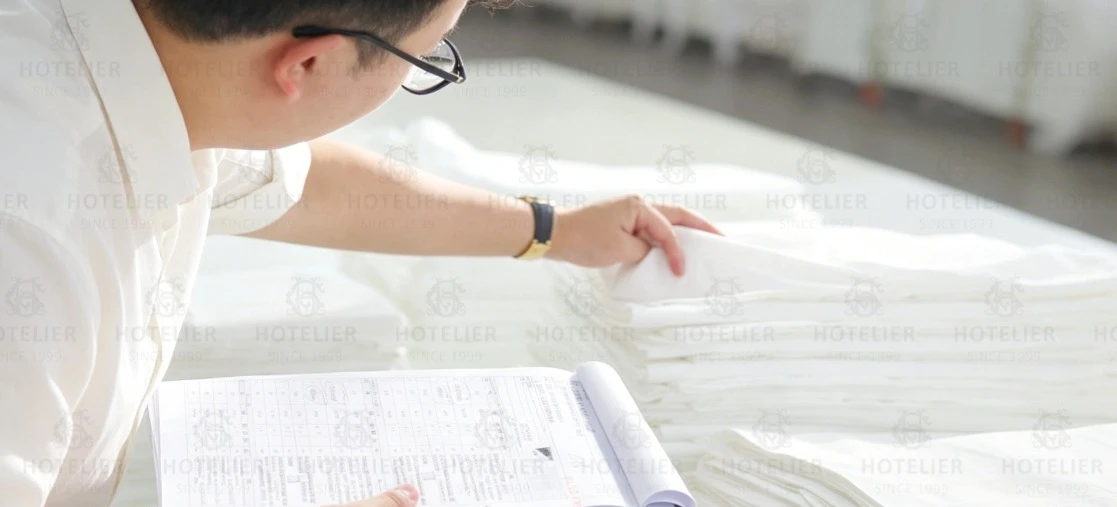
Core Dimensions of Hotel Linen Procurement
Never make purchasing decisions merely based on unit price and surface feel. 90% of star hotels around the world adopt a full-life cycle comprehensive cost accounting system to calculate the actual operating costs and avoid low-price traps.
1.One-off purchase unit price: The most intuitive one-time cost, which is only for reference rather than the core decision factor. Low-priced fabrics usually suffer from poor wash resistance and rapid wear.
2.Service life before replacement: The core cost indicator. It refers to the effective washing cycles before linens become pilled, faded, deformed or damaged to the point of scrapping, which directly determines the reuse value of each purchase.
3.Daily wear, loss and restocking cost: It covers implicit operating expenses such as replacement of worn-out products, supplementary orders, labor costs for sorting and replacement, as well as customer complaints caused by defective linens.
- Guided by this cost accounting logic, 72% of star hotels worldwide choose fabrics within 200–420TC (40s to 60s). High-count fabrics of 80s popular in the home textile market are applied in less than 1.2% of commercial hotels. The main reason is that most of these high-count fabrics are not optimized for industrial washing, resulting in high later-stage loss and overall operating costs.
II. Three Categories of Fabric Procurement Standards by Hotel Grade
2.1 40s (200TC Plain Weave)
40s pure cotton fabric is a cost-effective commercial linen proven by massive industry tests and tailored for high-frequency turnover. Featuring thick and sturdy yarns and stable fabric structure.Industry tests prove that this fabric can withstand more than 100 washing cycles before reaching the scrap standard, fully meeting the long-term operation needs of high-traffic hotels.
It is the preferred choice for budget chain hotels, roadside inns and economy business hotels. Its core advantage lies in controllable full-cycle costs: low initial procurement cost, low damage rate during industrial washing and stable replacement cycle, which perfectly fits the operation mode of economy accommodation with large passenger flow and frequent linen replacement.
2.2 60s (300TC Satin Weave)
60s single-ply combed long-staple cotton is the standard linen for four-star hotels. Woven with single long-staple cotton yarn, it features true and stable yarn count and density with consistent quality. Balancing long-term industrial wash resistance and premium skin feel, it is recognized as an all-round high-performance fabric in the industry.
This fabric boasts three core commercial strengths: excellent skin friendliness, air permeability and industrial durability. It maintains intact texture and stable color after long-term standardized chlorine bleaching, high-temperature washing and drying, with a stable service life of over 150 washing cycles.
2.3 80s & Above High-Count Fabric (400TC Satin Weave)
Premium 80s high-count fabric features an ultra-fine and soft touch and high-grade texture, which can greatly upgrade the luxurious ambiance of guest rooms. However, its ultra-high weaving density creates tiny fabric pores, making it less adaptable to high-frequency and high-temperature industrial washing. Such fabrics perform well for low-frequency household use, yet the fine yarn structure has poor tolerance to industrial cleaning in hotel scenarios.
Therefore, 80s fabrics are mainly used in ultra-luxury hotels under strict process selection and with professional washing conditions. Ordinary commercial hotels are not advised to adopt them blindly.
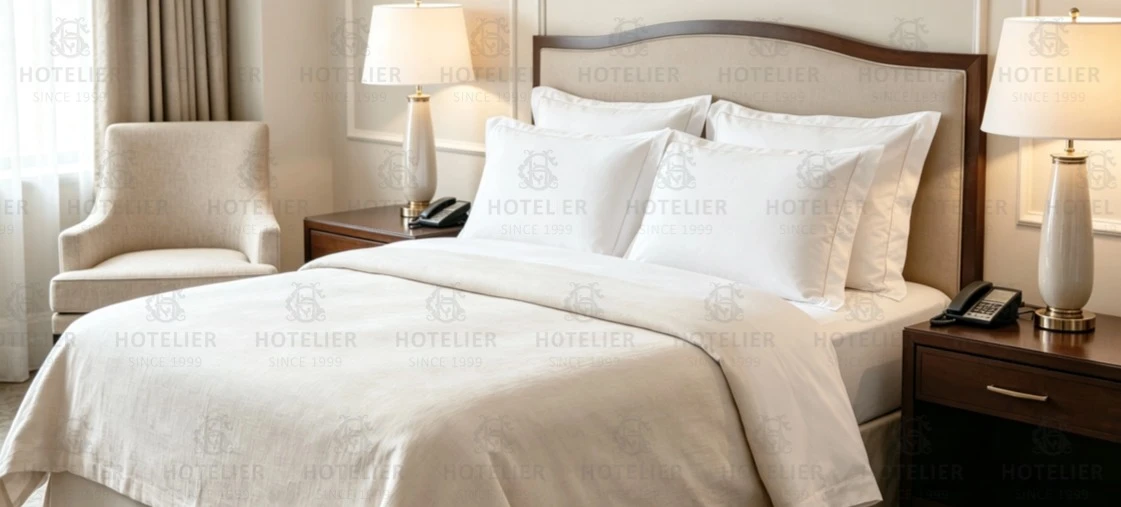
III. Full-Life Cycle Cost Comparison of Different Fabrics (Industry Test Data)
|
Fabric Specification |
Rated Washing Cycles |
Procurement Cost Level |
Applicable Hotel Type |
|
40s, 200-300TC |
Over 100 cycles |
Low-cost |
Budget chain hotels, economy business hotels, homestays |
|
60s, 300-450TC |
Over 150 cycles |
Medium-cost |
Four-star hotels, mid-to-high-end boutique hotels |
|
80s, 500TC+ |
Over 80 cycles |
High-cost |
Ultra-luxury boutique hotels, high-end resort hotels |
IV. Supporting Selection Rules for Hotel Linens
4.1 Selection Standards for Raw Materials and Weaving Processes
For raw cotton materials, high-end star hotels prefer Pima cotton and Egyptian long-staple cotton. With longer fiber length, higher toughness and tensile strength, these long-staple cotton fabrics can stay smooth, delicate and soft without hardening after hundreds of cycles of industrial high-temperature washing and chlorine bleaching, delivering excellent long-term appearance stability.
Budget chain hotels and economy accommodation usually adopt ordinary combed cotton. It meets the basic requirements of commercial durability and damage resistance while controlling procurement and operating costs, achieving optimal cost performance.
There are clear industry rules for weaving process selection:
- 40s linens for economy hotels mainly adopt plain weave, featuring a crisp surface, even pores, good air permeability and outstanding durability for high-frequency commercial washing.
- 60s linens for mid-to-high-end hotels mostly use satin weave, with delicate texture, soft luster and silky drape, which greatly improves room grade and guest experience.
- For 80s and above high-count fabrics, it is essential to distinguish weaving processes (single-ply or multi-ply) and cotton grades. Only single-ply fabrics made of high-toughness long-staple cotton can be used in high-end hotels with professional washing support, and they are not suitable for ordinary commercial hotels.
4.2 Standard Linen Turnover Ratio for Hotels
The universal linen turnover standard adopted by the global hotel industry: 3 sets of linens per guest room.
- One set for daily use in guest rooms;
- One set in circulation for off-site industrial washing;
- One set as backup inventory in the warehouse.
For scenic hotels and downtown business hotels with surging passenger flow in peak seasons, it is recommended to prepare one extra set of spare linens to avoid unavailable rooms caused by delayed washing and linen shortage, and ensure stable operation during full occupancy.
4.3 Industry Specifications for Linen Color Selection
Pure white is the universal standard color for hotel linens worldwide. Pure white fabrics are fully compatible with industrial high-temperature boiling washing and strong chlorine bleaching, featuring minimal color loss, superior durability and lowest maintenance cost, suitable for standardized washing procedures of all star-rated hotels.
Colored, dyed and printed linens cannot withstand commercial chlorine bleaching and high-temperature washing. They are prone to fading, discoloration and fabric damage, and require manual sorting and separate maintenance. Compared with pure white linens, the annual washing cost of colored linens increases by 10% to 15%. For this reason, they are only customized for a small number of themed boutique hotels and characteristic homestays, and not recommended for regular star hotels and chain hotels.

FAQs
1.Can high-end boutique homestays use 80s high-count linens as a selling point?
It can be applied with caution and strict quality inspection. Premium 80s fabrics made of high-precision long-staple cotton can upgrade room grade and guest experience and create differentiated advantages. The key for homestays to use 80s fabrics is to control process and quality, rather than blindly pursuing high yarn counts.
2. Can 40s polyester-cotton blend replace pure cotton for hotel linens?
It is only applicable to budget hotels and short-rental homestays. Polyester-cotton fabrics have good wrinkle resistance and lower purchase price, but the chemical fiber component weakens air permeability and skin friendliness, failing to meet the experience standards of star-rated guest rooms.
3. How to quickly identify qualified 80s high-count linens?
Check the product specifications. Prioritize genuine 80s fabrics made of high-toughness long-staple cotton with single-ply weaving for stable quality and low wear. Be cautious about products only marked as high-count and high-density without detailed process description.
4. Does a higher TC always mean better quality and higher value for purchase?
No. For commercial hotel linens, reasonable parameter matching matters more than simply pursuing high indicators. Fabrics with a TC over 500 are likely to overheat, turn brittle and pill during industrial high-temperature washing, leading to a shorter service life. 200–420TC is the optimal range verified by global hotel practices.
5. For new hotel opening procurement, should we choose ready-made goods or customized fabrics first?
Prioritize standard ready-made fabrics (conventional pure white 40s/60s) for hotel opening. They have short lead time and fit universal washing standards. After the hotel operates stably, you can customize linens with logos or special sizes according to room positioning and reorder demands, so as to avoid construction delays and risks related to customized products.
6. Why do 60s fabrics from different manufacturers have big differences in washing durability?
The core difference lies in post-finishing processes. High-quality commercial linens go through mercerization, pre-shrinking, color fixation and anti-pilling treatment to enhance resistance to chlorine bleach and high temperature. Ordinary 60s fabrics for home use have no such commercial reinforcement. Though they feel similar, they will develop lint, fading and shrinkage after only 30 to 50 industrial washing cycles.
7. Do linens with slight pilling need to be scrapped immediately?
No. Minor lint and slight pilling can be trimmed and handled by professional laundry services. Batch replacement is only required when large-area pilling, thinning, transparency, excessive shrinkage or stubborn yellowing and fading occur and affect room appearance and guest experience, so as to minimize operating loss.
8. How to avoid color difference for repeated orders in long-term cooperation?
Seal samples before mass production and confirm fabric specifications and weaving processes. Clarify requirements for the same raw materials and production techniques in the contract. Choose suppliers with self-owned factories and stable supply chains for long-term cooperation to prevent color and texture difference caused by changed raw materials or processes in restocking.
Conclusion
- Different from home textiles which focus on appearance and touch, hotel linen procurement takes commercial washing durability as the top priority. Household bedding markets high yarn count and soft feel, while hotel linens have to adapt to harsh working conditions with over 150 cycles of high-temperature washing, chlorine bleaching and mechanical rubbing every year. Therefore, durability outweighs pure softness and high yarn count.
- Standard 40s and 60s fabrics (200–420TC) are widely adopted by star hotels across the globe, because their parameters fit commercial washing requirements well with controllable loss and overall costs. By contrast, popular 80s ultra-high-count fabrics are only suitable for limited use in ultra-luxury hotels.
- Professional hotel linen procurement never relies on simple price comparison or blind pursuit of high yarn counts. Instead, it selects products reasonably based on scientific matching of yarn count and thread count, process inspection, as well as the hotel's grade and washing conditions, so as to build a stable and cost-effective linen supply system.